
When a Journalist Is Beaten, Where Is the Outrage?
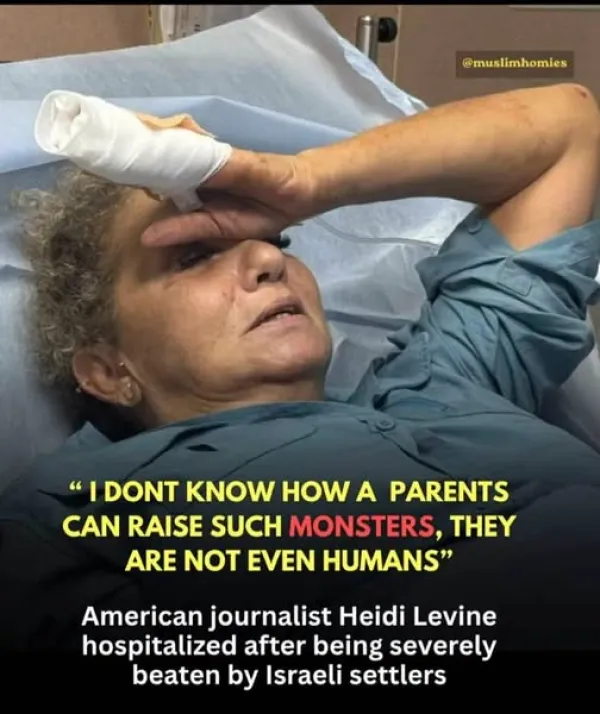
American journalist Heidi Levine hospitalized after being severely beaten by Israeli settlers The 63yo Washington Post photographer 'sustained fractures & other injuries while covering the olive harvest in Ramallah. Source: Palestinian Civil Affairs spokesman Imad Qaragra.
On October 16, 2026, Heidi Levine, a veteran photojournalist for The Washington Post, was brutally attacked by masked Israeli settlers while covering Palestinian farmers harvesting olives in the occupied West Bank. Wearing a vest clearly marked “PRESS,” Levine was knocked to the ground, kicked repeatedly, and beaten. Her injuries included four fractured vertebrae, a broken rib, and multiple lacerations. She also required surgery for other injuries. [Source: The Washington Post, October 16, 2026.]
Levine was doing what journalists are supposed to do: documenting events the world deserves to see. Instead, she became a victim of the very violence she was there to cover.
This was not simply an attack on one American journalist. It was an attack on the freedom of the press and the public's right to know what is happening on the ground.
An apology from former Israeli security officials
In the aftermath, more than a dozen former Israeli security, intelligence, and other senior officials sent Levine a letter expressing their outrage and shame over the attack. Their message was striking because it came from people who had devoted their careers to defending Israel.
“We are deeply ashamed that Jewish terrorists in the West Bank continue to inflict suffering on innocent Palestinians, assault those who come to their defense, and target those who document and expose their despicable conduct,” the letter stated.
The officials warned that such brutality brings disgrace upon Israel and the Jewish people and undermines the country's security and international standing. They also pointed to the need for a fundamental change in policy.
Their words deserve to be taken seriously. Condemning violence against Palestinians and those who document it should not be considered an act of hostility toward Israel. On the contrary, confronting wrongdoing is essential to the rule of law and to the credibility of any society that claims to uphold democratic values.
Netanyahu's response—and Levine's anger
Speaking from her hospital bed, Levine expressed outrage at Prime Minister Benjamin Netanyahu's suggestion that the attackers might have been trying to help her.
She described his characterization as “such a lie and the biggest insult.” According to Levine, the attackers were trying to rob her, not assist her.
Netanyahu subsequently suggested that reports of the attacks might be part of “a coordinated campaign to smear Israel” and West Bank settlers, while saying the facts remained unclear and were under investigation.
In this video shared on X, The Washington Post photojournalist Heidi Levine describes the attack and responds to the claims made about what happened. Watch the video here:
https://x.com/onionkknight/status/2111756221254672438?s=20
But when a journalist has been beaten, hospitalized, and left with multiple fractures, dismissing reports of the incident or suggesting that they are part of a campaign to damage a country's reputation raises serious questions.
The appropriate response should be to establish the facts, identify those responsible, and ensure accountability—not cast suspicion on the reporting before an investigation has run its course.
Levine has covered conflicts in the Middle East and elsewhere for decades. Her experience and the available video footage and eyewitness accounts deserve careful consideration. The evidence should be examined transparently, and those responsible should face the consequences if the allegations are substantiated.
Arrests are a start, not the end
On October 19, Israeli police announced arrests in connection with the weekend's violent incidents in the West Bank, including the assault on Levine and a separate attack involving European diplomats.
The arrests are an important development, but arrests alone do not constitute justice. Investigations must be thorough, charges must be supported by evidence, and prosecutions must follow where warranted.
The wider problem cannot be ignored. Settler violence against Palestinians, journalists, and international observers has repeatedly drawn criticism from human rights organizations and others monitoring the occupied West Bank. The olive harvest, a vital source of livelihood for many Palestinian families, has become another setting in which farmers face intimidation and violence.
Israeli authorities have a responsibility to protect civilians and journalists and to enforce the law impartially. That responsibility cannot depend on whether the victims are Palestinian, American, European, Israeli, or of any other nationality.
Nor should the issue be reduced to the actions of a few individuals without examining whether existing policies and enforcement failures allow such violence to continue.
Where is the outrage in Washington?
This brings me to a question for President Donald Trump and other American leaders.
On October 18, Trump publicly endorsed Netanyahu for reelection, praising him as a “Great Warrior Prime Minister” and a partner for peace. That endorsement came two days after the assault on Levine became public and one day after European diplomats were reportedly attacked in a separate incident in the West Bank.
Trump's endorsement does not, by itself, establish his position on the assault. But the timing raises a legitimate question: why has he not issued a clear, public condemnation of the attack on an American journalist and demanded accountability from the Israeli government?
To be fair, some American lawmakers did condemn the assault. Members of Congress called for an investigation and accountability, and the U.S. Embassy in Jerusalem also condemned criminal violence in the West Bank. These statements matter and should be acknowledged.
But the question remains whether American leadership will turn those expressions of concern into sustained diplomatic pressure for justice.
Would the response be the same if an American journalist had been beaten by Palestinians? Would the White House be equally restrained if the perpetrators belonged to a group opposed by the U.S. government?
These are fair questions, not because the nationality or political identity of an assailant should determine the response, but precisely because it should not.
An American journalist attacked while doing her job deserves the same concern and protection regardless of who attacks her. And Palestinian farmers deserve protection from violence for the same reason: their rights and safety should not depend on political calculations.
American aid and American accountability
The United States provides Israel with $3.8 billion annually in security assistance under the existing ten-year framework covering fiscal years 2019 through 2028. That assistance reflects a longstanding strategic relationship, but it also gives Washington a reason to insist that its ally uphold the rule of law and address violence against civilians and journalists. [Source: U.S. Department of State.]
American taxpayers have a legitimate interest in how their government uses its diplomatic influence and the resources it provides to foreign partners. Supporting Israel's security and demanding accountability for violence are not mutually exclusive positions.
If Israeli authorities investigate these attacks fairly and prosecute those responsible, that would be a necessary step. If the pattern of violence continues without meaningful accountability, American officials should explain what further measures they are prepared to support.
The issue is not whether the United States should care about Israel's security. It is whether the same principles of justice, human dignity, and press freedom are applied consistently.
A journalist's injuries are not the whole story
The attack on Heidi Levine is particularly disturbing because it happened while she was documenting violence against Palestinian farmers. Yet the central issue extends beyond one journalist, one olive harvest, or one weekend of unrest.
When journalists are assaulted, witnesses are intimidated, and those who report abuses are treated as enemies, the public loses access to information it needs to understand events and hold powerful institutions accountable.
The former Israeli security officials who wrote to Levine recognized the damage such violence inflicts on Israel's own standing and moral credibility. Their criticism should prompt serious reflection, not be dismissed as an attack on the country.
The Israeli government must ensure that the investigation proceeds transparently and that those responsible are held accountable. American leaders, meanwhile, should make clear that violence against journalists and civilians is unacceptable, regardless of the perpetrator's identity or political affiliations.
Freedom of the press cannot depend on the nationality of the journalist, the identity of the attacker, or the political convenience of the moment.
An attack on a journalist is an attack on the public's right to know.
And when an American journalist is beaten while documenting violence in the occupied West Bank, the public has every right to ask why the response from its own president has not been clearer.
Inquiring minds want to know.
Mahmoud El-Yousseph is a Palestinian freelance writer and retired U.S. Air Force veteran. He writes about U.S. foreign policy, Middle Eastern affairs, and justice